Hello Everyone over here I will provide a complete java tutorial and a basic overview of java in a short period of time.
Java is a high-level, class-based, object-oriented programming language that is widely used for building applications. Here are some key aspects and features of Java:
-
Object-Oriented: Java is based on the object-oriented programming (OOP) paradigm, which means it uses objects and classes to organize code into reusable and modular components.
-
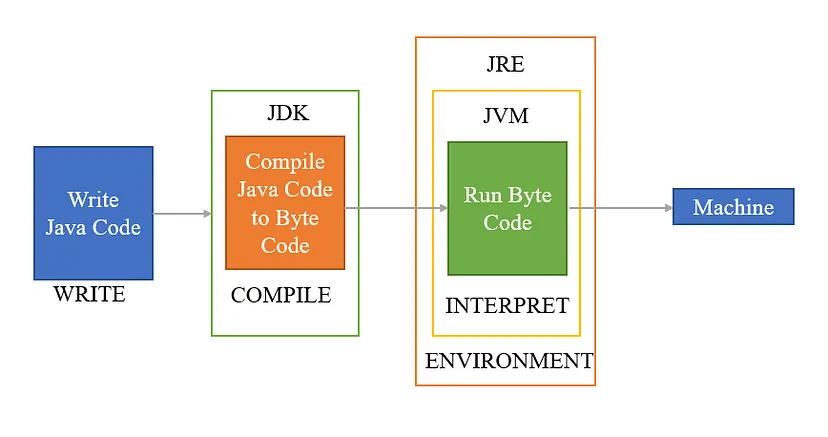
Platform-Independent: Java code is compiled into bytecode, which can run on any device equipped with the Java Virtual Machine (JVM). This feature is often summed up by the phrase "write once, run anywhere" (WORA).
-
Simple: Java is designed to be easy to learn and use. It has a syntax similar to C++, but with fewer low-level constructs.
-
Secure: Java has several built-in security features, including bytecode verification and a robust security manager, which help protect against malicious code.
-
Robust: Java emphasizes reliability through strong memory management, exception handling, and garbage collection.
-
Multithreaded: Java supports multithreading, allowing multiple threads to run concurrently, which is useful for developing responsive and efficient applications.
-
High Performance: While Java is an interpreted language, just-in-time (JIT) compilers and advanced optimizations make it performant.
-
Distributed: Java has extensive networking capabilities, making it suitable for building distributed applications.
-
Dynamic: Java is designed to adapt to an evolving environment, supporting dynamic loading of classes, and various runtime configurations.
-
Java Development Kit (JDK): The JDK is a software development kit required to develop Java applications and applets. It includes the Java Runtime Environment (JRE), an interpreter/loader (Java), a compiler (javac), an archiver (jar), a documentation generator (Javadoc), and other tools needed in Java development.
-
Java Runtime Environment (JRE): The JRE provides the libraries, Java Virtual Machine (JVM), and other components to run applications written in Java. It does not contain development tools like the JDK.
-
Java Virtual Machine (JVM): The JVM is an abstract computing machine that enables a computer to run Java programs. The JVM has three main components: Class Loader, Runtime Memory/Data Area, and Execution Engine.
-
Java Standard Edition (Java SE): This is the core Java platform, which provides all the necessary tools and APIs for general-purpose programming.
-
Java Enterprise Edition (Java EE): Built on top of Java SE, Java EE provides APIs and runtime environments for developing and running large-scale, multi-tiered, scalable, and secure network applications.
-
Java Micro Edition (Java ME): A subset of Java SE, Java ME is designed for resource-constrained devices such as embedded systems, mobile devices, and other consumer electronics.
-
Spring Framework: A comprehensive framework for enterprise Java development, offering extensive support for developing robust and scalable applications.
-
Hibernate: An object-relational mapping (ORM) framework that simplifies database interactions by mapping Java classes to database tables.
-
Apache Struts: A framework for creating enterprise-ready Java web applications.
-
JavaServer Faces (JSF): A framework for building user interfaces for web applications.